CIS 554 Assignment 2: Logic Puzzle
Spring 2010, David Matuszek
Purposes of this assignment
- To give you more experience with logic programming.
- To introduce lists in Prolog.
- To emphasize the declarative nature of Prolog. (The entire program consists of a statement of the problem, not some algorithm to solve the problem.)
General idea of the assignment
Solve a standard (commercial) logic puzzle.
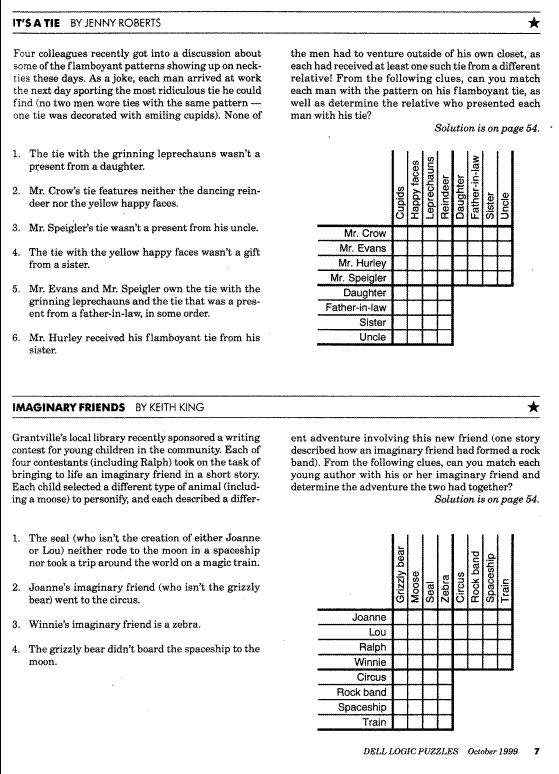
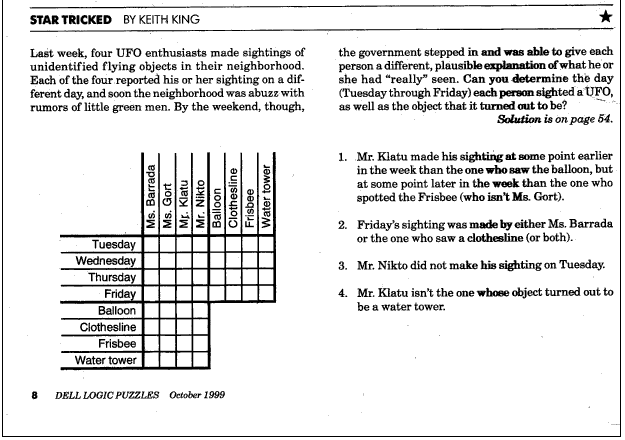
I am providing three such puzzles:
- It's a Tie -- I have provided a sample solution for this one.
- Imaginary Friends -- Once you understand the "It's a Tie" solution, this should be trivial. I suggest you implement this to get a better feel for how to do puzzles like this, but don't hand it in.
- Star Tricked -- Your assignment is to write (and turn in) a Prolog program to solve this logic puzzle. If you understand how the sample program works, it should be fairly easy to figure out how to describe the ordering of weekdays.
Notes:
- One of my problems in solving these was spelling errors. Prolog checks for singleton variables, but there is no such check for misspelled atoms, such as
spiegel instead of speigel. Be especially careful of this.
- These problems make unusually extensive use of the "not" operator,
\+. Here's what you need to know about this operator:
\+ works as you would expect when all variables are completely instantiated (bound).- Prolog tries to prove things, so if expression E contains unbound variables,
\+E will try to find variable bindings that will make E true.
Grading
This one should be easy to grade; your program should produce the correct solution. We may deduct points if your formatting is egregiously bad.
Due date
Tuesday, September 21, before midnight. Turn your .pl file in to Blackboard. Since only one file is required, please don't zip it.