CIT594 Third Quiz
Spring 2004 |
Name_________________________________________ |
Please read all questions carefully. Answer questions briefly
and to the point. You have plenty of room for correct answers.
For questions 1 to 5, use the following graph.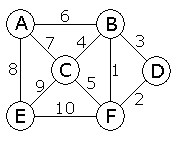
- Using Kruskal's algorithm, in what order would the edges be added
to a minimum-cost spanning tree? (Don't show your work.)
- Using Prim's algorithm, in what order would the nodes be added to
a minimum-cost spanning tree, assuming that you start from node
A?
(Don't show your work.)
- Using Prim's algorithm, in what order would the nodes be added to
a minimum-cost spanning tree, assuming that you start from node
C?
(Don't show your work.)
- If you used Dijkstra's algorithm to compute the shortest paths from node
A to every other node, you would end up with a collection of
edges pointing towards A. In the above graph, show the edges
that would be on these shortest paths by drawing arrowheads on each edge in
a shortest path.
- Represent (draw) the above graph as an adjacency matrix.
- Define the "heap property" for a node (as used in Heapsort).
- Consider an array containing the following numbers:
15 10 12 4 8 9 6 1 3 8
- Draw this array as a balanced, left-justified binary tree, as in Heapsort.
- Is this binary tree a heap? Why or why not?
- Assuming that arrays are 0-based (as in Java), give the formula for
finding:
- The index of the left child of node i.
- The index of the right child of node i.
- The index of the parent of node i.
- Assume you have the following backtracking algorithm:
boolean explore (Node N) {
   if N is a goal node, return true
   else if N is a leaf node, return false
   else for each child C of N {
          if (explore(C)) return true

   }
   return false
}
- What would you add to this algorithm to print out a successful path
(reverse order is okay)?
- How would you modify this algorithm so that it works on a directed
graph, instead of just a tree?
- Assuming you have correctly modified the algorithm to work on a directed
graph, what additional change could you make for an undirected
graph?
-
Suppose you are running a dating service, where you want to match up N gals
with N guys for dates tomorrow night. By using a questionnaire, you have decided
how happy each possible couple is likely to be (higher numbers are better).
For gals A, B, C and guys X, Y, Z, your table looks like this:
- If you use a greedy algorithm to pair up couples, what couples do you
form?
- Does your greedy algorithm maximize the average (arithmetic mean) happiness
of couples? Why or why not?
- Suppose that, instead of maximizing the average, you want to maximize
the worst case (so that the unhappiest couple are as happy as possible).
What pairings would you make?
- Describe (in words, not code) a simple brute-force algorithm for maximizing
the worst case (as in 9c).
- What is the running time of your brute-force algorithm? Is it fast enough
to be feasible for, say, 100 couples?
- Given the following set of frequencies, construct a Huffman encoding for
the letters
A thru J.
A 20% |
B 3% |
C 8% |
D 12% |
E 6% |
F 9% |
G 16% |
H 11% |
I 14% |
J 1% |
Your results:
A = |
B = |
C = |
D = |
E = |
F = |
G = |
H = |
I = |
J = |