Science Fiction
My name is David Matuszek, and this page is about my science
fiction. (My computer science books are here.)
I like Murderbot as much as anyone, but that's not my
style. I grew up reading Hal Clement and Isaac Asimov, back when
ideas rather than action were central to the story. This page
describes the ideas I had in mind when I wrote these stories.

An "Ice Jockey," in my book, is a spaceman who goes out into
the Kuiper Belt, locates large, water-rich asteroids, and
"jockeys" them on an orbit towards Mars. The protagonists, Bob
and Holly, have a somewhat unconventional romantic relationship.
But that's all in the story.
One way I had a lot of fun was in analyzing in detail exactly
what kind of equipment would be required to mount a fusion
engine to an asteroid and sending it to Mars.
The ship itself is fusion powered, and carries twelve fusion
engines on its exterior (so it looks nothing like the beautiful
ship the cover artist made for me). When one of the engines is
used to mount on an asteroid, that unbalances the ship, so how
can balance be restored? That provided a marvelous logical
puzzle, and I spent hours with diagrams working out the details.
This isn't belabored in the book, but there's enough there to
engage readers who like puzzles.
There are bad guys, and conflict, but that's all in the story.
But to me there is a third main protagonist, usually hostile,
and that is space itself; specifically, zero gravity (or "free
fall"). Most of the actual action takes place in zero gravity,
where objects have no weight but still plenty of mass. Most
science fiction readers will understand this intellectually, but
I think the events and descriptions in the book support a
gut-level understanding. I worked hard to get everything exactly
right; how to live inside the ship, how to work outside.
I'll be the first to admit that plots are my weak point. (The
book has a plot, okay? What more do you want?) My characters
don't have any hidden traumas or deep secrets; in fact, I only
write sensible, competent characters that make reasonable
decisions. Why? Those are the kind of people I know and like,
the kind of people in my own life. I may not be great at plots,
but at least my characters don't do stupid things in order to
keep the plot going.
The ship's pilot is an AI, but that's hardly science fiction
any more.
Also, by the way, sorry about the subtitle, which I admit
sucks.

Here's the plot. Scientists develop life extension, then
government outlaws it. In order to keep using it, two
billionaires build a starship, staff it with a hundred competent
people, and fly to a distant planet. The natives realize how
much of a long-term threat this is, and plan to destroy the
human colony. In the end, peace is achieved.
Now you know the plot, so why bother reading the book? It's
like the romance novels my wife reads (she shares the best ones
with me): You know how it's going to end, the fun is in getting
there.
The natives (who, by the way, look like human-sized geckos with
an extra pair of arms) are not bad guys; they are gentle, peace
loving people who really don't like the fact that they have to
kill all the humans.
I really enjoyed crafting the aliens. Their biology, and in
particular their means of reproduction, makes a possible to have
a conflict-free society, in a way that humans can never achieve.
Their planetary conditions determine the limits of their
science. They are as intelligent as humans; they, not the
humans, figure out how the two species can communicate with each
other. (No miracle "universal translators" here.)
In Mirror Dance by Lois Bujold, one of the characters
states that "All true wealth is biological." This describes the
natives. The title of the book should really be All True
Wealth, but I didn't want it confused with financial
books.
A little girl is the real hero of the story, but nobody notices
that (and less alert readers will probably also miss it).
A lot of the fun is in the human-native-human interactions.
Let's face it--I love my characters. Even Gunnar, who was
supposed to be a minor character but somehow managed to screw
things up (he gets what he deserves.) I like intelligent,
competent people, even if they're aliens. (Or goats. It turns
out that goats are pretty amazing--who knew?)
Oh, and music is fundamental to the plot.

This is a sequel to All True Value. Sixty years after
the events in that book, a second starship arrives, headed by a
cult leader (Jacob) with the crew as his flock. Jacob refuses to
treat the natives as other than animals, and fears losing
control of his flock. (This was written before Trump came to
power, so any parallels are coincidental.) Jacob comes into
conflict with both the natives and the original colonists. As in
the first book, there isn't a conventional happy ending--nobody
wins completely--but is the best that might realistically occur.
Jacob is a Bad Guy. I don't find characters very convincing
when they do bad things "because they're bad guys," but Jacob is
a complete narcissist who has a sweet deal going, so he has a
lot to lose.
The main characters are Helen, her brother Troy, and their
companion Music Explainer. The central problem is to find a way
to neutralize Jacob, but most of the story is about our heroes
meeting and getting along with (or not) the cult members, some
of whom have their faith in Jacob shattered by events. They are
(almost) all good people.
This isn't Earth; problems have to be solved the way the
natives solve problems, and Helen and Troy are deeply involved
with them in doing so. The solution they find is in part
uniquely human, in part uniquely native.
This book has a lot more action and a lot more plot than its
predecessor.
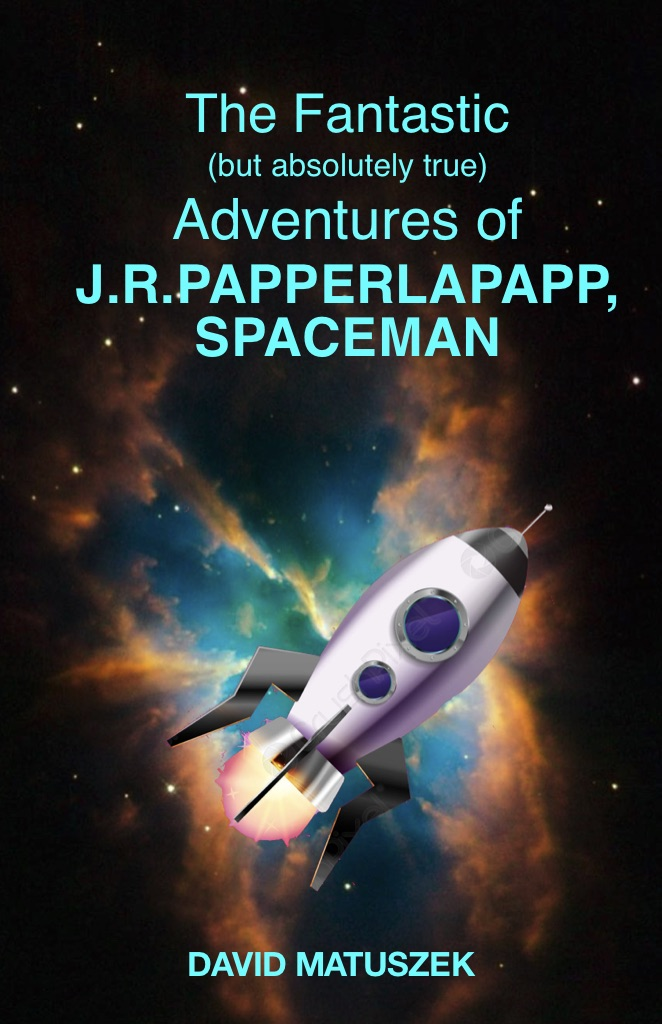
This book isn't published yet, and may never be. As you can
guess from the home-made cover, it's not exactly serious science
fiction. The field needs more tall tales, and Pappy is here to
fill in for Paul Bunyan. But scientifically, of course.
J.R. Papperlapapp ("Pappy" to his friends) is a spaceman
prospector, always on the hunt for gold. Sometime he gets it,
sometimes he doesn't, but he never keeps it for long.
I love that name. When I was hunting for the right name, I
discovered that "papperlapapp" is German slang for "balderdash."
And "Pappy" really fits my character. He is based on an old
western actor, Gabby Hayes, whom probably no one nowadays has
even heard of, and that's a pity. I am all but certain that
Gabby Hayes is the inspiration for the character in Blazing
Saddles, Gabby Johnson, who speaks in "authentic frontier
gibberish." If you've seen the movie--well Pappy isn't usually
that angry, but I don't know of a more similar character.
So far there are a couple of dozen stories. Did you know that
on blue gas giant planets, it might rain diamonds? Pappy will be
there. Or that gold is produced in colliding neutron stars?
Pappy will be there. I like to take a standard science fiction
trope and twist it until gold drips out, but the right ideas are
difficult to come up with. So there's also the occasional
gold-hoarding dragon, or a leprechaun who needs to get rid of a
rainbow.
The biggest problem I see to making a book out of these (once I
have enough) is the same problem that books of jokes have. No
matter how funny the joke, after reading several in a row, they
lose their appeal. Now, if a major science fiction magazine
wanted to run a series, you have my email address!